


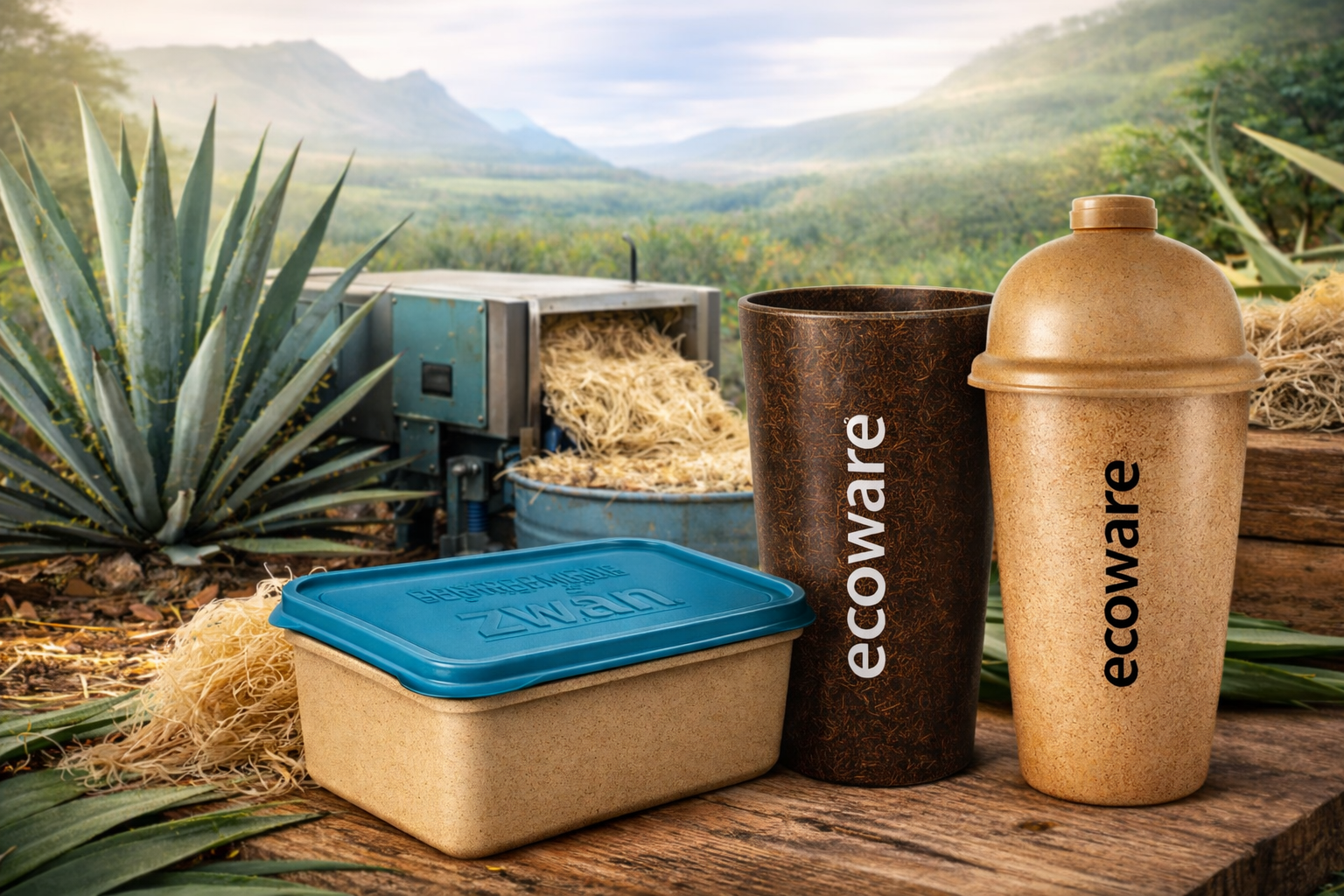
Imagine an agave field under the sun. After the harvest, what remains often looks like waste: fibers, plant residues, tons of material that traditionally had no second life.
Now imagine that this “waste” doesn’t end up forgotten, but instead begins a new journey. A process where innovation, technology, and design transform it into something entirely different: durable, functional eco-friendly products with a positive environmental impact.
This transformation is not accidental. It is vision.
For decades, industry operated under a linear logic: use and discard. Today we are witnessing something far more powerful—the ability to turn what was once waste into opportunity.
Agave fiber is not just a material. It is a symbol of how the circular economy can redefine the future of eco-friendly products.
And this story is only beginning.
Every year, agricultural industries generate millions of tons of organic waste. For a long time, these by-products were considered inevitable and of little value.
The issue is not only the volume—it is the missed opportunity.
When residues are not reintegrated into productive cycles, energy is lost, resources are wasted, and the demand for virgin raw materials continues to grow.
This is where eco-friendly products can change the narrative.
True sustainability is not only about reducing harm. It is about redesigning systems so they work in closed loops, where what was once waste becomes a valuable resource.
Agave is widely known for its role in the beverage industry. However, once the main processing is complete, a significant amount of plant fiber remains.
For years, this fiber had limited applications or was simply discarded. But when viewed through the lens of sustainable innovation, it reveals something different: natural strength, lightweight properties, and structural potential.
Through responsible processes of cleaning, drying, and transformation, agave fiber can become the foundation for high-performance eco-friendly products.
This transformation is not improvised. It involves:
The result is eco-friendly products that not only reduce waste but also demonstrate how discarded materials can become valuable resources.
The circular economy proposes a model where materials remain in use for as long as possible, maximizing their value while minimizing the extraction of new resources.
Agave fiber fits perfectly within this logic.
Instead of relying on petroleum-based materials, manufacturers can use a resource that already exists within agricultural production chains.
This approach leads to:
Eco-friendly products made from plant fibers represent a profound shift. They do not simply replace plastic—they redefine the origin of materials.
One common mistake is thinking sustainability is only about the material used. In reality, design plays an equally important role.
Eco-friendly products must meet real performance standards. They must be functional, durable, and competitive.
When innovation aligns with sustainability, the result is not an inferior alternative product, but a superior solution.
Agave fiber enables the creation of eco-friendly products that combine:
This is not merely substitution—it is evolution.

In a market saturated with generic “green” messaging, authenticity makes the difference.
Eco-friendly products made from agave fiber tell a concrete story: the transformation of waste into solutions.
This narrative is not superficial. It is tangible, verifiable, and aligned with the principles of circular economy.
At Ecoware, we believe that leading sustainability means doing more than following trends. It means investing in innovation with purpose.
Agave fiber is not just an input material. It is proof that sustainability can be technical, strategic, and economically viable.
The next stage of eco-friendly products will not simply be about “doing less harm.” It will be about regeneration.
Materials that come from agricultural processes.
Designs that optimize resources.
Systems that integrate entire production chains.
The magic of agave fiber lies not only in the process itself, but in the vision it represents: an economy where nothing is wasted and everything can be transformed.
And that model is not a distant future.
It is already happening.
Know more abour our ecofriendly products.